
Free Sewing Pattern Printable
Printable sewing patterns for beginners and quick projects: tote bag, drawstring bag, envelope pillow cover, kitchen apron, zip pouch and scrunchie. Each comes with measurements, a cutting layout, step-by-step instructions and pattern pieces that tile on Letter or A4 paper.
- Instant download
- Editable Word & Excel
- Print-ready PDF
- 7-day refund
7 files · PDF, DOCX, XLSX
Beginner Sewing Pattern Pack
Six printable beginner sewing patterns with cutting layouts and instructions, a tiling guide and a fabric requirements workbook.
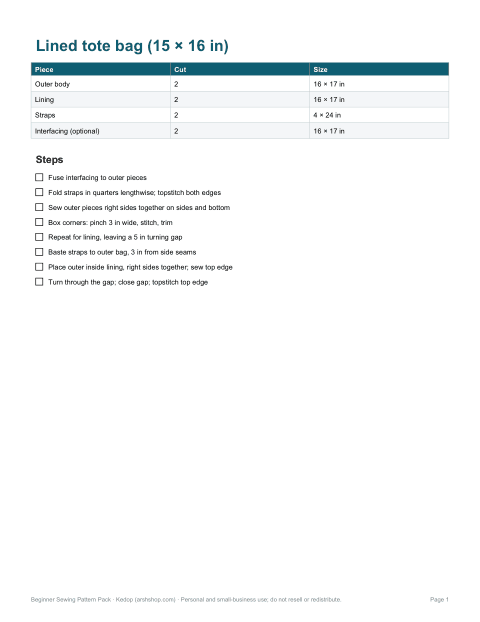
- Lined tote bag (PDF, DOCX)
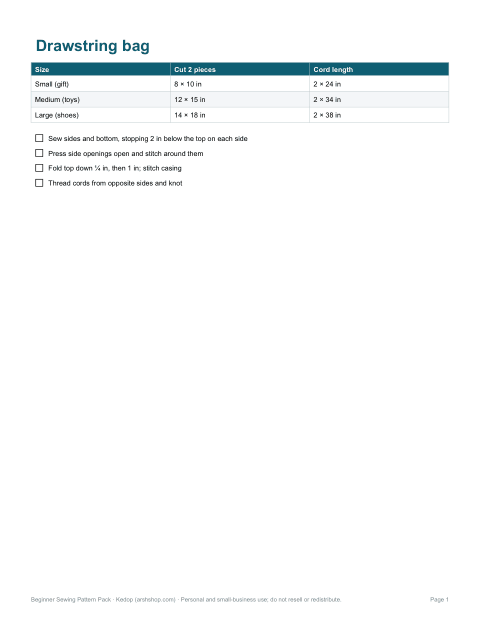
- Drawstring bag (3 sizes)
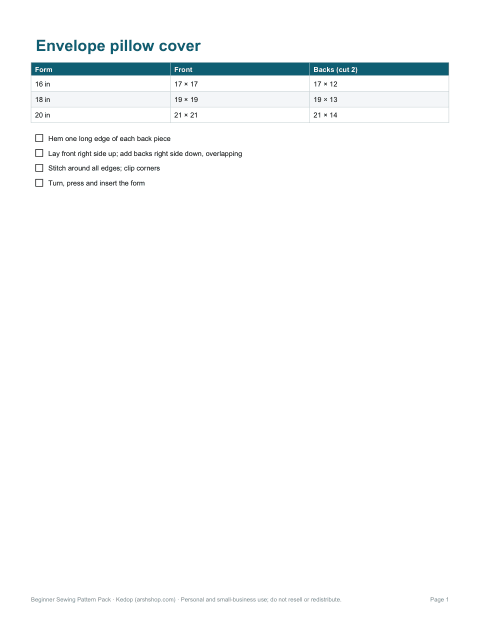
- Envelope pillow cover (PDF, DOCX)
- + 4 more
$7.00 USD, one-time 7 files · about $1.00 each
- Instant download
- 7-day refund
- Secure checkout by Stripe
7-day money-back guarantee. Full refund within 7 days of purchase, even after you download.
Free sample: Tote Bag Pattern (PDF, 51 KB)
Beginner Sewing Pattern Pack
Six printable beginner sewing patterns with cutting layouts and instructions, a tiling guide and a fabric requirements workbook.
- Lined tote bag (PDF, DOCX)
- Drawstring bag (3 sizes)
- Envelope pillow cover (PDF, DOCX)
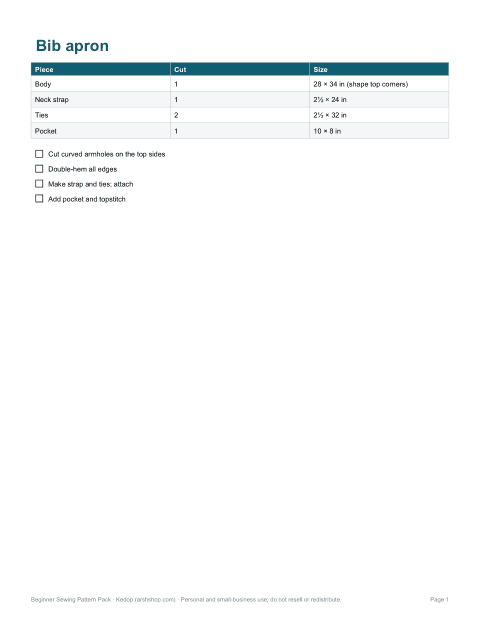
- Kitchen apron (PDF, DOCX)
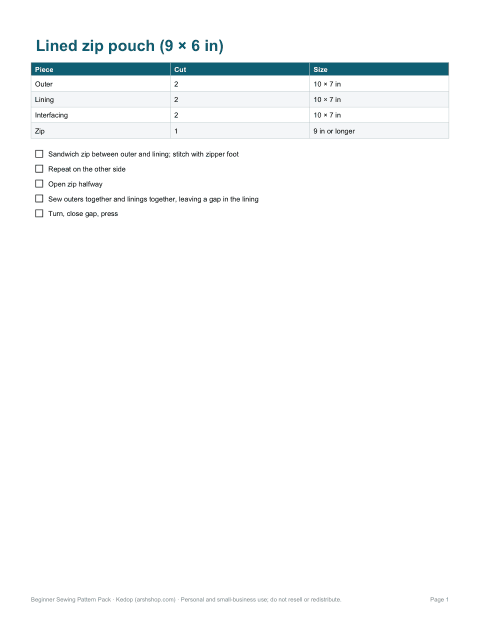
- Lined zip pouch (PDF, DOCX)
- Tiling guide & planner (PDF, DOCX)
- Fabric requirements workbook (XLSX, PDF)
Formats: PDF, DOCX, XLSX. Instant download after payment (link valid 72 hours, up to 5 downloads). AI-assisted: the templates were drafted with AI help and reviewed and laid out before publishing.
$7.00 USD, one-time 7 files · about $1.00 each
- Instant download
- 7-day refund
- Secure checkout by Stripe
7-day money-back guarantee. Full refund within 7 days of purchase, even after you download.
Free sample: Tote Bag Pattern (PDF, 51 KB)
Full refund within 7 days — see the refund policy and license.
Free printables
Single sheets you can print right now, no sign-up. The full pack adds every sheet in one download plus the editable files.
 Printable Lined Tote Bag Pattern1 page · free PDF
 Printable Drawstring Bag Size Chart1 page · free PDF
 Printable Envelope Pillow Cover Pattern1 page · free PDF
 Printable Kitchen Apron Pattern1 page · free PDF
 Printable Lined Zip Pouch Pattern1 page · free PDF
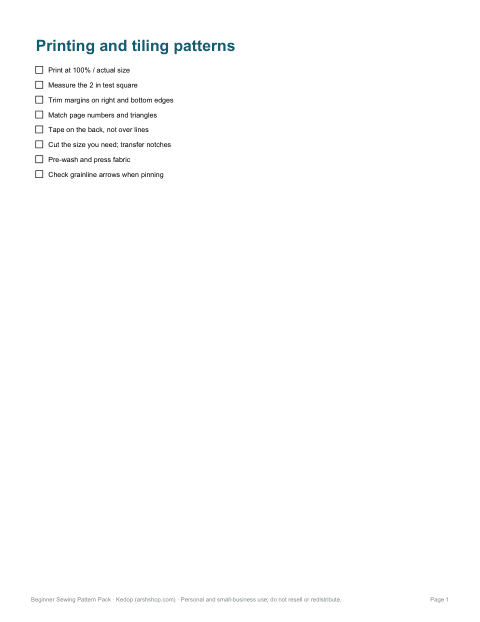
 Printable Sewing Pattern Tiling Guide1 page · free PDF
 Printable Fabric Requirements Workbook2 pages · free PDF
What is in the pattern pack
- Lined tote bag — 15 × 16 inch bag with boxed corners and sturdy straps.
- Drawstring bag — three sizes, for shoes, toys and gifts.
- Envelope pillow cover — no zip needed; cutting chart for common pillow form sizes.
- Kitchen apron — adult bib apron with adjustable neck strap and pocket.
- Zip pouch — a lined pencil or make-up pouch, the classic first zip project.
- Scrunchie — a quick scrap-buster.
- Tiling guide — how to print, align and tape multi-page pattern pieces.
- Project planner — fabric requirements, notions and cutting checklist for each project.
How to print sewing patterns correctly
- Print at 100% or “Actual size” — never “Fit to page”.
- Measure the test square on the first page with a ruler: it should be exactly 2 × 2 inches (or 5 × 5 cm). If it is not, check your printer settings before printing the rest.
- Trim or fold the margins of each page along the guide lines.
- Match the page numbers and alignment marks, and tape the pages together.
- Cut out the pattern piece in the size you need.
Many simple projects in this pack are rectangles, so you can also skip printing entirely and measure the pieces straight onto fabric using the cutting charts.
Choosing fabric
| Project | Suggested fabric | Approx. yardage (44 in wide) |
|---|---|---|
| Tote bag | Canvas, denim, duck or home décor cotton; quilting cotton for lining | 1 yd outer + 1/2 yd lining |
| Drawstring bag | Quilting cotton, linen, lightweight canvas | 1/3–1/2 yd |
| Pillow cover (18 in) | Cotton canvas, linen, home décor fabric | 5/8 yd |
| Apron | Cotton twill, canvas, denim | 1 yd |
| Zip pouch | Quilting cotton + fusible interfacing | Fat quarter |
| Scrunchie | Quilting cotton, velvet, satin | 4 × 22 in strip |
Pre-wash cotton and linen before cutting, because they can shrink, and press the fabric flat so the pieces are accurate.
Beginner skills these projects teach
- Cutting accurately and marking seam allowances.
- Sewing straight seams and pivoting at corners.
- Pressing seams open and to one side.
- Boxing corners for bags with a flat bottom.
- Making a casing for a drawstring or elastic.
- Inserting a zip with a zipper foot.
- Topstitching for a neat, professional finish.
Seam allowances and measurements
Unless a pattern says otherwise, the projects use a ½ inch (1.3 cm) seam allowance for bags, aprons and pillows and ¼ inch for the scrunchie. Seam allowances are included in the cutting sizes. Measurements are given in inches with centimetre equivalents. If you change a size — for example, a pillow cover for a 20-inch form — the planner shows how to recalculate: finished size plus two seam allowances, and for envelope backs an overlap of about 4–5 inches.
Pillow cover sizes
| Pillow form | Front piece | Two back pieces (each) |
|---|---|---|
| 16 × 16 in | 17 × 17 in | 17 × 12 in |
| 18 × 18 in | 19 × 19 in | 19 × 13 in |
| 20 × 20 in | 21 × 21 in | 21 × 14 in |
| 12 × 20 in lumbar | 13 × 21 in | 13 × 14 in |
Formats
Patterns and instructions are print-ready PDFs; instructions and planners also come as editable Word files, and the fabric calculator as an Excel workbook. Pattern pages include a test square and tile on both US Letter and A4 paper.
Safety and care
Keep rotary cutters closed when not in use and pins in a pincushion rather than on the table. Unplug the iron when you finish. When sewing children's items, avoid small detachable parts and follow local rules on drawstrings in children's clothing — drawstring bags in this pack are for storage, not for clothing. Follow the fabric care label when washing finished projects.
Frequently asked questions
Are these patterns suitable for beginners?
Yes. Most are rectangles and straight seams; the zip pouch introduces one new skill.
What paper size do the patterns print on?
US Letter and A4. Always print at 100% and check the test square.
Can I sell items I make from these patterns?
Yes, you may sell finished items you sew yourself. You may not share or resell the pattern files.
What seam allowance is used?
½ inch for most projects and ¼ inch for the scrunchie, included in the cutting sizes.
Was AI used to create the patterns?
The instructions and layouts were drafted with AI assistance and then reviewed, measured and formatted before publishing.